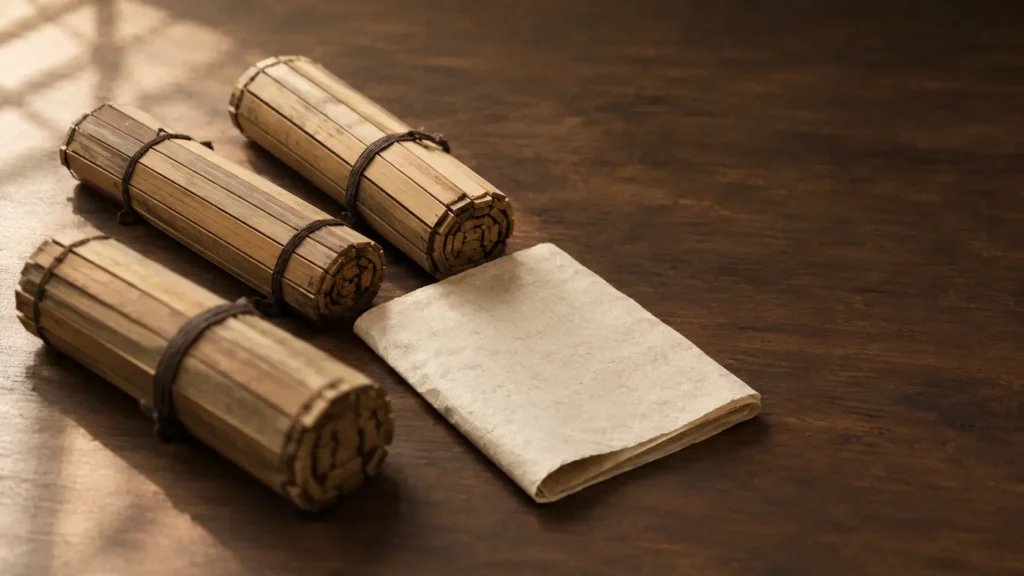
Most fake Confucius quotes were never meant to sound like him. They are English sayings that found their way to the most recognisable Chinese name in circulation, and the Analects is where they fall apart. It’s a book of conversations, not maxims: Confucius speaks to named disciples, argues with them, gets told off, and occasionally loses. Any line that arrives without a person on the other end of it is already suspect.
Fake Confucius quotes at a glance
| Line | What it really is | Cite this instead |
| “Choose a job you love, and you will never have to work a day in your life.” | American career advice from 1982 | Analects 2.15 — learning and thinking need each other |
| “Our greatest glory is not in never falling, but in rising every time we fall.” | Oliver Goldsmith, 1760, written as fiction | Analects 15.30 — the fault is not reforming it |
| “I hear and I forget. I see and I remember. I do and I understand.” | The Xunzi, a different book by a different man | Analects 2.15, or Xunzi 8 if you want the original |
| “Before you embark on a journey of revenge, dig two graves.” | A Japanese proverb, called that in English by 1924 | Analects 14.34 — return injury with straight dealing |
| “Better a diamond with a flaw than a pebble without.” | Jiao Hong, Yutang Congyu (1540–1620) | Analects 13.23 — concord without agreement |
| “Life is really simple, but we insist on making it complicated.” | Aero Digest, 1949 | Analects 9.19 — the mound one basket short |
| “The man who moves a mountain begins by carrying away small stones.” | Nothing. No source has ever been found | Analects 9.19, which is about stopping, not pace |
| “It does not matter how slowly you go as long as you do not stop.” | Nothing. No source has ever been found | Analects 9.19 |
| “A journey of a thousand miles begins with a single step.” | Laozi, Tao Te Ching ch. 64 | Tao Te Ching 64, not the Analects |
Every genuine line in that right-hand column carries a chapter number, and that’s the whole test. A real quotation from the Analects can always be located, because the book has been divided into twenty chapters since roughly the Han dynasty and every modern edition numbers them the same way.
Why does the Analects attract invented lines?
The usual explanation is that a short, aphoristic text is easy to forge. That works for the Tao Te Ching, which names nobody and argues with nobody, so an invented sentence has nothing to bump into. It doesn’t work here. The Analects is almost entirely dialogue. Confucius is asked questions, gives answers that change depending on who is asking, gets challenged by Zai Wo, gets sighed over by Yan Hui, and spends a memorable afternoon refusing to see a visitor while playing his lute loud enough to be heard through the door. There’s context everywhere.
And that’s precisely why the mechanism is different. Nobody forges a line into this book. What happens instead is that a self-contained English sentence, whether it’s career advice, a grief aphorism or a proverb about revenge, gets a name attached to it afterwards, and the name chosen is the one Chinese thinker an English speaker can produce without looking. You can see the seam if you look for it. Fake Confucius quotes arrive bare; the real ones tend to arrive with a situation still hanging off them.
Two things make it worse. First, Confucius is a Latinised name that most people meet as a joke. The “Confucius say” construction was an American vaudeville and newspaper gag long before the internet, and a figure who is already half-comic is an easy place to park a saying nobody can source. Second, the genuine material is genuinely quotable and short, so a fake only has to clear a low bar. It needs to sound vaguely Eastern and vaguely old. None of the nine lines above does more than that, and four of them aren’t old at all.
Eight fake Confucius quotes, and where they came from
Did Confucius say “Choose a job you love”?
No. The line is American and it is recent.
“Choose a job you love, and you will never have to work a day in your life.”
— Not Confucius. Ann Woolfolk, Princeton Alumni Weekly 83(5), 6 October 1982, p. 32, quoting Arthur Szathmary, who credited an unnamed source. The Confucius attribution begins turning up in print from 1985.
This is the single most-repeated fake Confucius quote on the internet, and it’s the easiest to date, which makes it a useful one to know. Three years after it appeared under Woolfolk’s byline, it started appearing with Confucius’s name on it, and by the 1990s it had hardened into a fact that career counsellors repeated without checking.
There is room for this one to be treated properly, and I have done that in Did Confucius Say “Choose a Job You Love”? Where It Came From. That piece goes through the Woolfolk page itself, Szathmary’s unnamed source, and the two Analects passages people reach for when they want to rescue the line.
What makes it obviously not his is the premise. The sentence assumes you have a choice of occupation, and that the point of one is personal fulfilment. Confucius took students regardless of what they could pay, “From the man bringing his bundle of dried flesh for my teaching upwards, I have never refused instruction to any one” (Analects 7.7 · 自行束脩 以上,吾未嘗無誨焉 · trans. Legge, 1861), but the teaching wasn’t vocational. It was about becoming a certain kind of person, which is a different project entirely.
If you want a genuine line about how learning actually works, the one to use is 2.15:
“Learning without thought is labour lost; thought without learning is perilous.”
— Analects 2.15 · 學而不思則罔,思而不學則殆 · trans. Legge, 1861
Legge writes labour. It was 1861 and he was Scottish. Leave it alone; it’s what he printed.
Did Confucius say “Our greatest glory is not in never falling”?
No, and this one has a better story than any of the others, because the man who wrote it was already pretending to be Chinese.
“Our greatest glory is not in never falling, but in rising every time we fall.”
— Not Confucius. Oliver Goldsmith, The Citizen of the World (1760–62), Letter VII.
The Citizen of the World is a series of fictitious letters written in the voice of Lien Chi Altangi, an invented Chinese philosopher visiting London and sending dispatches home. Goldsmith was satirising English manners through a foreign visitor’s eyes, which was a well-worn device by 1760. Montesquieu had done it with Persians. So the line was composed as Chinese philosophy by an Irishman who had never been to China.
The reassignment happened in 1831, when a London magazine reprinted the passage and credited it to Confucius. From there it went everywhere, and it has since been pinned on Nelson Mandela, Vince Lombardi and Ralph Waldo Emerson as well. A quotation that migrates between famous names is a quotation nobody has checked; the four-way attribution is itself the evidence.
I have dated the Goldsmith letter, the 1831 magazine that moved the line, and each of the later attributions in Our Greatest Glory Is Not in Never Falling: Goldsmith, 1762.
The nearest genuine thought isn’t about rising. It’s about what you do afterwards:
“To have faults and not to reform them,– this, indeed, should be pronounced having faults.”
— Analects 15.30 · 過而不改,是謂過矣 · trans. Legge, 1861
The Chinese says the fault is not correcting the fault. Falling barely registers.
Did Confucius say “I hear and I forget”?
No. This one has a real home in Chinese, just not in the book people think it is.
“I hear and I forget. I see and I remember. I do and I understand.”
— Not Confucius. A compressed version of a passage in the Xunzi, a third-century BCE text by a philosopher who argued that human nature needs deliberate shaping.
The original runs in four steps rather than three, and the difference matters:
“Not to have heard is not as good as having heard; having heard is not as good as having seen; having seen is not as good as knowing; knowing is not as good as acting. Learning reaches its end in acting.”
— Xunzi 8「儒效」 · 不聞不若聞之,聞之不若見之,見之不若知之,知之不若行之,學至於行之而止矣 · translated from the Chinese
The viral version collapses “knowing” and “acting” into one step, which is exactly the part Xunzi was arguing about. He thought the whole ladder existed to get you to the last rung, and that stopping anywhere below it left you with something useless. I have checked this passage against the original more than once, because I have seen it sourced to Confucius, to Xunzi, and to “ancient Chinese proverb” in the same week, and it’s the one that most often gets defended when corrected. It feels Chinese enough to be true. It is Chinese. It’s the Xunzi, and Xunzi isn’t Confucius.
Did Confucius say you should dig two graves before seeking revenge?
No. It’s Japanese, and it was labelled as Japanese in English print long before anyone thought to attach a Chinese name to it.
“Before you embark on a journey of revenge, dig two graves.”
— Not Confucius. A Japanese proverb, 人を呪わば穴二つ, described as Japanese in English from 1924. It was used as the opening epigraph of the television series Revenge (2011), which is where most English speakers met it.
The reason it reads as plausible is that revenge is a topic the Analects takes up directly, and someone asked him about it. His answer isn’t a proverb about mutual destruction:
“Recompense injury with justice, and recompense kindness with kindness.”
— Analects 14.34 · 以直報怨,以德報德 · trans. Legge, 1861
Legge’s “justice” is 直, straightness or uprightness. The questioner had proposed 以德報怨, returning injury with kindness, and Confucius’s objection is practical: if you return injury with kindness, what’s left to return kindness with? The fake and the genuine line disagree, and they disagree in a way that’s easy to remember once you’ve seen both.
Did Confucius say “Better a diamond with a flaw than a pebble without”?
No. It is Chinese, but it is late, and the man who wrote it lived two thousand years after him.
“Better a diamond with a flaw than a pebble without.”
— Not Confucius. Jiao Hong (1540–1620), Yutang Congyu, ch. 5: 寧為有瑕玉,不作無瑕石. It reached English through Mohammed Sirajul Islam, Everyman’s General Knowledge (1967).
This is one of only two lines on this page that are genuinely from a Chinese source, and it’s worth noticing what that means: a Ming-dynasty compiler’s collection of anecdotes is roughly as distant from Confucius as Chaucer is from us. Being Chinese isn’t the same as being his.
For a real line about valuing something imperfect over something that merely looks clean, 13.23 is the one:
“The superior man is affable, but not adulatory; the mean man is adulatory, but not affable.”
— Analects 13.23 · 君子和而不同,小人同而不和 · trans. Legge, 1861
The distinction is between concord and mere agreement, and it’s a distinction about how to be with other people, which is closer to the spirit of the diamond line than the diamond line is.
Did Confucius say “Life is really simple, but we insist on making it complicated”?
No. It’s from an American aviation trade magazine.
“Life is really simple, but we insist on making it complicated.”
— Not Confucius. Aero Digest, Vols. 58–59, p. 115 (1949).
I want to be careful about this one, because “we could not find an earlier source” isn’t the same claim as “there is no earlier source,” and I haven’t seen every page of every 1940s trade journal. What I can say is that no Chinese text contains it, that nothing resembling it appears in the Analects, and that the sentence is built out of mid-century American self-help vocabulary.
It also contradicts him. Confucius thought getting a life right was slow and difficult work, and said so repeatedly. The passage that gets closest to the sentiment people want is about giving up near the end:
“The prosecution of learning may be compared to what may happen in raising a mound. If there want but one basket of earth to complete the work, and I stop, the stopping is my own work.”
— Analects 9.19 · 譬如為山,未成一簣,止,吾止也 · trans. Legge, 1861
The mound is one basket short and he stops. That’s his example, and he picks it because it’s the opposite of reassuring.
Did Confucius say “The man who moves a mountain begins by carrying away small stones”?
No, and this is one of two on the page for which no source has ever been produced in any language.
“The man who moves a mountain begins by carrying away small stones.”
— Not Confucius. No origin found; it has search volume of its own and no provenance behind it.
Mountains don’t appear in the Analects. Hills appear once, in a line about the wise finding pleasure in water and the virtuous in hills (6.23), and even that is a remark about temperament rather than about perseverance. The mountain-and-small-stones pairing is a modern motivational image, and motivational images are the largest single category of fake Confucius quotes. When a line reads like a poster, it usually is one.
Did Confucius say “It does not matter how slowly you go as long as you do not stop”?
No. Same status as the mountain: widely shared, no source, no Chinese original, nothing in the corpus that could have generated it.
“It does not matter how slowly you go as long as you do not stop.”
— Not Confucius. Unsourced. It is often printed next to the mountain line, which is a hint about where both of them live.
If you want a genuine line about persistence, 9.19 above is the honest choice, and it says the harder thing. The fake promises that pace doesn’t matter. His actual example says that stopping one basket short is yours to own.
The lines his own students said
This is the category nobody checks, and it’s where most of the genuinely interesting misattribution lives. The Analects isn’t a book of Confucius’s opinions. It’s a book in which other people speak, and four passages routinely printed under his name are spoken by somebody else.
The speaker’s name is in the text. That’s the whole reason this is checkable, and the whole reason it gets missed. Quote sites strip the attribution line and keep the sentence.
“In practising the rules of propriety, a natural ease is to be prized.”
— Analects 1.12 · 禮之用,和為貴 · trans. Legge, 1861. Spoken by You Zi, not Confucius.
和為貴 is one of the most-quoted four-character phrases in Chinese and it’s on calligraphy scrolls all over the world. It’s in the first chapter, Xue Er, and it’s You Zi’s line. Legge’s “natural ease” is 和, harmony, and the second half of the passage complicates it. Ease has to be held in check by ritual, or it isn’t worth having. A quotation that stops at 和為貴 drops the qualifier.
“Then all within the four seas will be his brothers.”
— Analects 12.5 · 四海之內,皆兄弟也 · trans. Legge, 1861. Spoken by Zi Xia to Sima Niu, who was upset that he had no brothers.
This is condolence offered to a specific person. It isn’t a doctrine about universal brotherhood, though it gets printed as one.
“If the superior man abstains for three years from the observances of propriety, those observances will be quite lost. If for three years he abstains from music, music will be ruined.”
— Analects 17.21 · 君子三年不為禮,禮必壞;三年不為樂,樂必崩 · trans. Legge, 1861. Spoken by Zai Wo, arguing that the three-year mourning period is too long.
And this is the best one, because Confucius’s reply isn’t a refutation of the argument. It’s a question about whether Zai Wo would feel at ease eating good rice and wearing embroidered clothes a year after his parents died. Zai Wo says he would. Confucius tells him to go ahead, and only after Zai Wo has left the room does he say anything like a judgement: 予之不仁也, which Legge renders as “This shows Yu’s want of virtue.” The passage sits in the seventeenth chapter, Yang Huo, and the argument Confucius actually makes is that a child isn’t out of its parents’ arms until it is three.
One more, from outside the book entirely. 食色,性也, eating and sex are human nature, is attributed to Confucius constantly in English. It’s in the Mengzi, and the speaker is Gao Zi, a philosopher whose position Mencius spends the chapter attacking. A line a text records in order to disagree with it ends up quoted as the master’s own view, which is about as far as misattribution can go.
How to check a Confucius quote in a minute
- Look for a chapter number. Anything with a real Analects source has one, usually written Analects 12.5 or Lunyu XII.5. No number means nobody looked.
- Look for a person being spoken to. Most of the book is dialogue. If the line has no interlocutor and no situation, it probably isn’t from here.
- Open Legge’s 1861 Analects, which is free plain text and searchable. Paste the exact wording in.
- Check the Chinese. A distinctive four-character phrase is enough to settle it, and the Chinese Text Project carries the original by chapter.
- Check who is speaking. If the passage is attributed to Confucius and the text says “the philosopher You said,” you have your answer.
The last step is the one that catches the most errors, and it’s the one every quote site skips, because quote sites don’t reproduce the line of text that says who is talking.
Frequently asked questions
Did Confucius say “Choose a job you love, and you will never work a day in your life”?
No. It comes from the Princeton Alumni Weekly, 6 October 1982, where Ann Woolfolk quoted Arthur Szathmary, who himself credited an unnamed source. The Confucius attribution appears from 1985. It’s the most widely shared of all fake Confucius quotes.
Which famous quotes are wrongly attributed to Confucius?
The nine on this page, and the pattern behind them is worth knowing. Some are modern Western sentences with his name attached afterwards, like “Choose a job you love” and “Life is really simple.” Some are genuinely Chinese but belong to other books or other centuries, like the Xunzi ladder and Jiao Hong’s diamond. Some are proverbs from other cultures entirely, like the Japanese “dig two graves.” And some are his own students’ lines, stripped of the name of the person who said them.
Are Confucius quotes in the Analects reliable?
The Analects is our earliest and best source, and it’s a compilation assembled by his students and their students over perhaps two centuries, so it’s a record rather than a transcript. What it isn’t is a book of free-floating maxims. Every passage has a speaker and most have a setting, which makes it far more checkable than the texts people usually compare it to. The same test applied to the Laozi debunks turns up a different failure rate, and the Sun Tzu one different again, because the three books invite forgery in three different ways.
Where can I find real Confucius quotes with sources?
Start with a chapter number and work outward. The genuine lines on learning are collected separately in Confucius quotes on learning, since that’s the theme with the largest body of material, and they’re worth reading alongside this page if you want the contrast between what he said and what gets attributed to him.