Most lines sold as fake Sun Tzu quotes are not in The Art of War. The book is thirteen chapters of roughly 6,000 characters, written as a working manual for commanders, and its central claim is that the best victory involves no battle at all: “To fight and conquer in all your battles is not supreme excellence; supreme excellence consists in breaking the enemy’s resistance without fighting” (Art of War III.2, trans. Giles, 1910). What circulates under his name today comes mostly from films, forewords and business books. Below, each line is traced to where it actually started.
Fake Sun Tzu quotes at a glance
Eight of the lines most often pinned on Sun Tzu, what they really are, and the passage worth quoting instead. Every genuine line below carries a chapter number, which is how you check it.
| “Sun Tzu” line | What it actually is | What The Art of War says instead |
| “Keep your friends close, but your enemies closer.” | Michael Corleone in The Godfather Part II (1974) | III.18, on knowing the enemy and knowing yourself |
| “Strategy without tactics is the slowest route to victory.” | No print translation; earliest book citation 2002 | VI.27, on what observers cannot see |
| “In the midst of chaos, there is also opportunity.” | No print translation; often mis-sourced to ch. V | V.16, on seeming disorder that is not disorder |
| “The true objective of war is peace.” | James Clavell’s foreword to the 1983 edition | II.6, on no state gaining from a long war |
| “In peace prepare for war, in war prepare for peace.” | A reworking of the Latin si vis pacem, para bellum | VII.19, on plans dark as night |
| “Opportunities multiply as they are seized.” | No print translation; a recent coinage | VI.28, on never repeating a won battle |
| “Fear is the true enemy, the only enemy.” | Star Trek: The Next Generation, 1987 | III.3, on breaking the enemy’s plans |
| “To know your enemy, you must become your enemy.” | No print translation; also credited to Genghis Khan | III.18, and note the word order |
What did Sun Tzu actually say?
Before the fakes, it helps to hear the real thing. Sun Tzu is credited with a book that reads like a briefing paper rather than philosophy, and The Art of War rarely wastes a sentence on anything edifying. Four passages show the shape of it.
The best victory is the one you don’t have to fight
“Hence to fight and conquer in all your battles is not supreme excellence; supreme excellence consists in breaking the enemy’s resistance without fighting.”
— Art of War III.2 · 是故百戰百勝,非善之善者也;不戰而屈人之兵,善之善者也 · trans. Giles, 1910
Note 屈, which means to bend or bring to heel, not to resist. Giles is glossing. Notice too that this is the strongest sentence in the book, and it is a sentence about not doing the thing we imagine. The third chapter, Attack by Stratagem, then sets out a descending ladder of preferences:
“Thus the highest form of generalship is to baulk the enemy’s plans; the next best is to prevent the junction of the enemy’s forces; the next in order is to attack the enemy’s army in the field; and the worst policy of all is to besiege walled cities.”
— Art of War III.3 · 故上兵伐謀,其次伐交,其次伐兵,其下攻城 · trans. Giles, 1910
Siege is last, and it is described as a disaster. This matters because the modern reputation runs the other way. The book is quoted most often by people selling a contest.
Disorder on the surface, order underneath
“Amid the turmoil and tumult of battle, there may be seeming disorder and yet no real disorder at all; amid confusion and chaos, your array may be without head or tail, yet it will be proof against defeat.”
— Art of War V.16 · 紛紛紜紜,鬥亂而不可亂也;渾渾沌沌,形圓而不可敗也 · trans. Giles, 1910
Hold this next to “in the midst of chaos there is also opportunity,” which is what most people think the book says. The real line is about how your own formation looks to the other side, and about whether it holds. It assumes the disorder is a surface you control. Two verses earlier the chapter compares stored force to a bent crossbow and release to pulling the trigger, and the line after says plainly that simulated disorder postulates perfect discipline. The chapter is called Energy, 勢, meaning purchase and leverage. It is not about looking for openings in a mess.
Nobody has profited from a long war
“There is no instance of a country having benefited from prolonged warfare.”
— Art of War II.6 · 夫兵久而國利者,未之有也 · trans. Giles, 1910“In war, then, let your great object be victory, not lengthy campaigns.”
— Art of War II.19 · 故兵貴勝,不貴久 · trans. Giles, 1910
This is the closest the text comes to a statement of purpose, and it is an accounting statement. War eats money, equipment and men, and while your army sits outside a city another state may take advantage, which is the argument Giles gives just before these lines. Giles immediately adds his own summary of the whole chapter: only someone who knows the evils of war well can understand the profitable way to carry it on. Costs and speed. Nothing about peace as an aim.
Whatever worked once, don’t do it again
“All men can see the tactics whereby I conquer, but what none can see is the strategy out of which victory is evolved.”
— Art of War VI.27 · 人皆知我所以勝之形,而莫知吾所以制勝之形 · trans. Giles, 1910
Look at the Chinese. Both halves turn on 形, form or disposition, and Giles has split one word into two English ones, which he hasn’t done anywhere else., and this is the single place in his translation where both “tactics” and “strategy” appear together, which is precisely why the forged line about them gets pinned to this chapter. The argument is about what observers can and can’t see, and then it turns:
“Do not repeat the tactics which have gained you one victory, but let your methods be regulated by the infinite variety of circumstances.”
— Art of War VI.28 · 故其戰勝不復,而應形於無窮 · trans. Giles, 1910
Then comes the water passage, 兵之形避實而擊虛, avoiding the solid and striking the hollow. If you have seen a “be like water” poster, note which book it isn’t from. That line belongs to Bruce Lee reading Laozi, which is traced on the fake Lao Tzu quotes page. Sun Tzu’s own water line is about going around strength, not about becoming fluid.
Why does The Art of War attract invented lines?
The book has no stories in it. There is no dialogue, no battle described after the fact, no named commander praised or blamed, only imperatives about terrain, spies, morale and supply. Nothing in it can contradict a sentence someone invents, because nothing in it hangs together as narrative in the first place. That makes it an unusually smooth surface, and it doesn’t push back.
It counts things too, and counted lists invite additions. It names five ways of knowing who will win, six kinds of ground, five classes of spy, nine situations an army can be in. A forged line that also comes in fives feels native to the text by rhythm alone. The Chinese military strategy pages here cover that wider tradition, most of which is far stranger than the one book everyone quotes.
Transmission did the rest. Lionel Giles made it available to English readers in 1910 and it stayed a specialist’s book for seventy years. The mass-market turn came with cheap editions aimed at executives in the early 1980s, and one of those editions produced a fake of its own, which you’ll see discussed below. Then came film and television: a line spoken by Michael Corleone in 1974 acquired Sun Tzu’s name afterwards, and fifteen years later a science-fiction episode handed him another. Both get laid out below, and they’re easier to date than most of these lines, which is part of the joke.
After that, professional repetition launders the line. A military journal essay in 2017 called the strategy-and-tactics couplet probably the most misattributed quotation of Sun Tzu in the West and counted roughly half a dozen senior officers and officials, including well-known strategists, who had used it in print. Once a flag officer has said it in an op-ed, a reporter will repeat it, and after that it’s got a citation trail that looks like evidence.
The embedded reason is that the text already says things modern readers want an ancient authority to say: win without fighting, check yourself first, pick ground rather than weight. The enthusiasm is more or less honest. The wording usually isn’t.
How to check a Sun Tzu quote in a minute
Five checks, in the order I run them. A fake Sun Tzu quote that survives all five would be the first I have seen.
- Look for a chapter number. The book is thirteen chapters, and every real quotation from it carries one, because that is how anyone finds anything in it. Roman numerals and a verse number are a good sign; no chapter at all is a bad one.
- Check how many authors it has. If the same sentence is credited to Sun Tzu and also to Machiavelli, Petrarch, Genghis Khan or Mark Twain, you are looking at a floating proverb that has been shopping for a name.
- Open Giles. His 1910 translation is free plain text on Project Gutenberg. Paste the exact wording in and see what comes back. If only one modern version has the line and Giles doesn’t, it is the translator’s sentence, not Sun Tzu’s.
- Watch the vocabulary. “Opportunity” isn’t a category the book works with. Neither is the modern pairing of strategy against tactics, nor peace stated as the object of war. Their presence is itself evidence.
- Check the Chinese. Search a distinctive phrase at ctext.org. It doesn’t have to be long; four characters is usually enough to find the verse.
Which Sun Tzu quotes are fake?
Eight fake Sun Tzu quotes, taken one at a time. Every line below has been credited to Sun Tzu in print or on television, and none appears in any translation I could find. Each has another home.
Did Sun Tzu say “Keep your friends close, but your enemies closer”?
“Keep your friends close, but your enemies closer.”
— Not Sun Tzu.
Michael Corleone says it in The Godfather Part II, released in December 1974, in a screenplay by Mario Puzo and Francis Ford Coppola: “My father taught me many things here. He taught me in this room. He taught me: keep your friends close but your enemies closer.” No printed source has been found that predates the film. It has also been credited to Machiavelli and to Petrarch, neither of whom wrote it, and the American Film Institute ranked it fifty-eighth among movie quotations in 2005. The nearest real line is III.18, below, which is about reconnaissance and self-knowledge. Entertaining your rival is not in it.
Did Sun Tzu say “Strategy without tactics is the slowest route to victory”?
“Strategy without tactics is the slowest route to victory. Tactics without strategy is the noise before defeat.”
— Not Sun Tzu.
This one appears in no printed translation of the book. The earliest citation anyone has turned up in book search is from 2002, and the wording has no counterpart in the Chinese: nothing in chapter six can plausibly be read as a slow road to victory or noise before defeat.
There is also a category problem. The book’s chapters are laying plans, waging war, attack by stratagem, dispositions, energy, weak points and strong, terrain, fire and spies. The modern split between strategy and tactics isn’t how it is organised, even though Giles uses both English words once, in VI.27 quoted above. That single coincidence is probably why this line feels like it belongs. It is the most cited forged Sun Tzu line in Western writing on strategy, and it is about twenty years old.
Did Sun Tzu say “In the midst of chaos, there is also opportunity”?
“In the midst of chaos, there is also opportunity.”
— Not Sun Tzu.
Nothing in print. The line is usually attributed to the fifth chapter, Energy, and the fifth chapter does contain the words confusion and chaos, which is presumably how it started. But read what surrounds them, quoted above in full: the claim is that a disciplined array can look disordered and survive, and the line right after says that order may generate disorder deliberately. Nothing in it promises you an opening. The forward-looking, optimistic reading is a late twentieth-century business version of the text, and it inverts what V.16 actually argues.
Did Sun Tzu say “The true objective of war is peace”?
“The true objective of war is peace.”
— Not Sun Tzu.
James Clavell wrote it in his foreword to the 1983 Dell edition of the book. Whether he coined it or took it from somewhere is unclear, because similar words had been in circulation before: a Japanese educator named Hiroshi Hatanaka was reported in the Pacific edition of Stars and Stripes on 10 February 1949 saying that the real objective of war is peace. Either way it isn’t in the thirteen chapters.
The real second chapter is blunter and less comfortable: nobody has gained from a long war, and your object should be victory rather than a lengthy campaign. That is doctrine about speed and cost. It isn’t an argument for peace, though II.6 is the verse usually meant when people insist the sentiment is “basically there.”
Did Sun Tzu say “In peace prepare for war, in war prepare for peace”?
“In peace, prepare for war. In war, prepare for peace.”
— Not Sun Tzu.
It is a twin of the Latin si vis pacem, para bellum, and the earliest appearance anyone has found in book search is 1920, in a pharmaceutical journal, with no author attached. The phrase gets bolted onto the front of the book’s opening sentence so often that it now reads to some people as part of it. The opening asks you to weigh five things before committing: the moral law, heaven, earth, the commander, and method and discipline. Preparation appears throughout, but this balanced couplet has Roman timing, not Warring States timing. The line people usually want when they reach for it is VII.19:
“Let your plans be dark and impenetrable as night, and when you move, fall like a thunderbolt.”
— Art of War VII.19 · 難知如陰,動如雷震 · trans. Giles, 1910
Did Sun Tzu say “Opportunities multiply as they are seized”?
“Opportunities multiply as they are seized.”
— Not Sun Tzu.
No printed translation contains it, and it doesn’t sit well against the text, which holds that advantage comes from preparation you control rather than chances that turn up. A related line, “quickness is the essence of war,” circulates alongside it on the same pages and is equally unsourced. If you want the real principle, VI.28 covers it: don’t repeat a tactic that already won for you, because circumstances never arrive twice. What looks like opportunism in this book is close attention to a situation that will not repeat.
Did Sun Tzu say “Fear is the true enemy, the only enemy”?
“Fear is the true enemy, the only enemy.”
— Not Sun Tzu.
Commander William Riker attributes it to Sun Tzu in “The Last Outpost,” Star Trek: The Next Generation, first broadcast in November 1987. Nothing predates the episode. It’s the cleanest fake on this page, because you can date the moment it entered English to the year. The text does discuss morale, and it does say that the best generalship works on the enemy’s plans and his alliances rather than on his courage, but it never says this, and it wouldn’t have put it that way.
Did Sun Tzu say “To know your enemy, you must become your enemy”?
“To know your enemy, you must become your enemy.”
— Not Sun Tzu.
This one usually travels attached to the “keep your friends close” line, and it is sometimes credited to Genghis Khan, which is the tell described above. Here is what the book does say:
“If you know the enemy and know yourself, you need not fear the result of a hundred battles. If you know yourself but not the enemy, for every victory gained you will also suffer a defeat. If you know neither the enemy nor yourself, you will succumb in every battle.”
— Art of War III.18 · 知己知彼,百戰不貽 · trans. Giles, 1910
Now the part every poster leaves out. The Chinese puts 知己 first: know yourself, and then the other side. Some editions write the last clause 不殆 rather than 不貽, but the order of the nouns is constant. The viral version reverses it, and also turns knowing into becoming, which is a much larger claim. Reconnaissance has limits; the text keeps them.
Three more, briefly. “Victory is reserved for those who are willing to pay its price” has no printed source I have found, and one editor notes it may have come from an animated series rather than a book. “A leader leads by example, not by force” I cannot source to any translation, and the closest real passage is X.25, which is harder-edged: “Regard your soldiers as your children, and they will follow you into the deepest valleys; look on them as your own beloved sons, and they will stand by you even unto death.” “Kill one, terrorize a thousand” is a Chinese idiom, not from this text.
The pattern behind all of them is worth knowing: the fake Confucius quotes page runs on exactly the same mechanism, and so does the Laozi one.
Frequently asked questions
Did Sun Tzu write The Art of War?
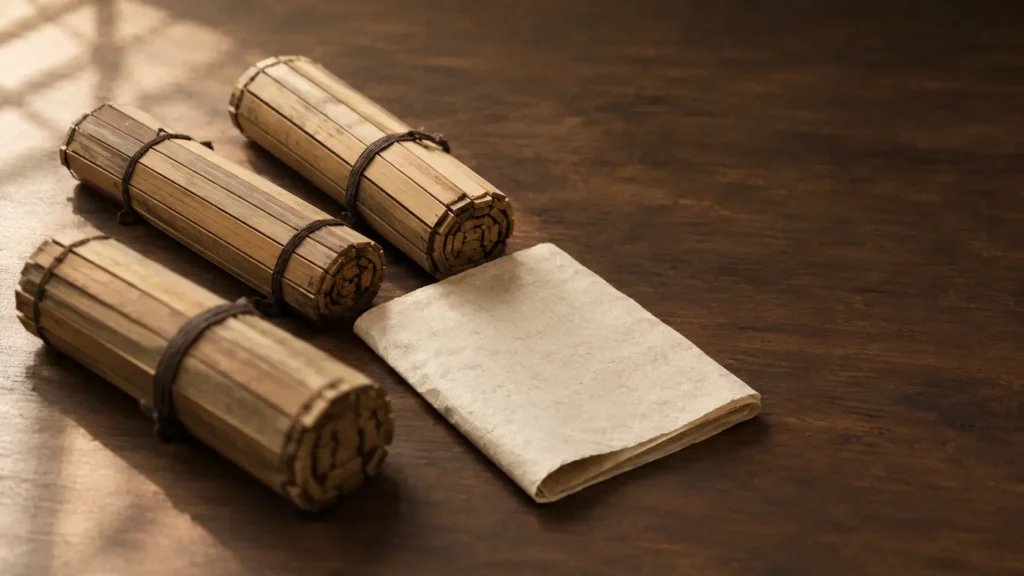
Tradition attributes it to Sun Wu, a general in the state of Wu in the late sixth century BCE. In 1972 archaeologists opened two Western Han tombs at Yinqueshan in Shandong and found nearly 5,000 bamboo slips written around 140 to 118 BCE, including both this book and the long-lost Art of War of Sun Bin. That settled a Song-dynasty argument over whether Sun Wu existed at all. Most scholars still treat the received thirteen chapters as compiled and edited over time.
What is the most famous fake Sun Tzu quote?
“Keep your friends close, but your enemies closer” gets the most shares, and it comes from a 1974 film. Among people who work in strategy, the line about tactics and strategy circulates more widely and is also invented.
Is “All warfare is based on deception” genuine?
Yes, and it’s I.18: 兵者,詭道也. Understand what it covers. The same verse lists Pretend inferiority and encourage his arrogance, and attack him where he is unprepared, appear where you are not expected. It is deception on the battlefield, addressed to a commander, not advice about how to run a negotiation. It’s also not advice you can quote at a supplier without distorting it.
Why do business books quote him so much?
Because the central claim is that winning without fighting beats winning by fighting, which is a comfortable thing to hear from an authority two and a half thousand years old, and because the book is short, imperative and largely free of context, so almost any sentence can be lifted out and laid flat.
Where can I check a Sun Tzu quote?
Open Giles’s 1910 translation, which is free and searchable, and look for the chapter. Then check the Chinese phrase at the Chinese Text Project. If a line has no chapter number in either place, don’t attribute it.